Convert JSON, CSV, and XML

Convert JSON to CSV, XML and HTML

Convert JSON to CSV, XML or HTML, import CSV as structured JSON or XML, and verify mapping and output choices before using the result.

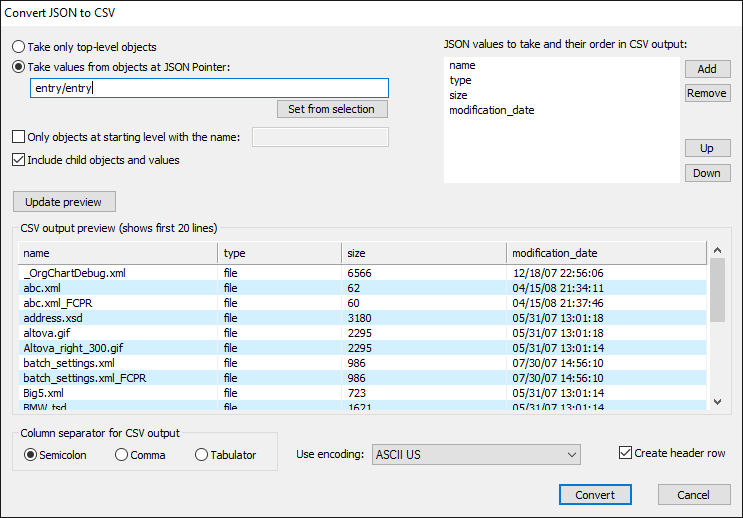
JSONBuddy dialog for converting JSON data to CSV
The conversion dialog shows a concrete JSON-to-CSV workflow with selectable input and output settings.
  • CSV importCreate JSON or XML
  • XML + JSONTransform both directions
  • JSON to CSVPreview structured output

Core conversion workflows

Convert between JSON, CSV, XML and HTML with visible controls

JSONBuddy keeps the source, mapping choices, preview, and generated result close enough to inspect before the transformed data enters another application or automated process.

Import CSV text

Read CSV from spreadsheets, databases, or text exports; choose the separator and encoding; rename or exclude columns; and create JSON, XML, or HTML.

Convert between XML and JSON

Transform documents in either direction, configure the conversion in a dedicated dialog, and preserve XML attribute or namespace information when the target needs it.

Create CSV from JSON

Select child objects and values with JSON Pointer paths, preview the tabular rows, and generate CSV for Excel or another CSV-aware application.

A concrete JSON-to-CSV workflow

Choose the starting array, columns, and output format

  1. Open the JSON document; use the large-file view when the input should not be loaded in an ordinary editor mode.
  2. Start the JSON-to-CSV command and set the JSON Pointer location of the array that contains the rows.
  3. Choose the values that should become columns and order them for the intended consumer.
  4. Set headers, character encoding, column separator, and other output options.
  5. Preview representative rows, run the conversion, and inspect the new CSV document before use.

Check the mapping before export

Verify the details that formats represent differently

Keep the unchanged source available until the converted output has passed its downstream checks. A successful conversion is only the first check. JSON objects and arrays, XML elements and attributes, and CSV rows and columns do not express every structure in the same way. Review a representative result before converting the complete data set.

JSON to CSV

Confirm that the selected array represents the intended rows, nested values map to useful columns, headers are stable, and separators or encodings open correctly in the target spreadsheet or database tool.

CSV to JSON or XML

Check column names, excluded fields, empty cells, numeric-looking identifiers, dates, delimiters, quoted text, and character encoding. Keep identifiers as strings when leading zeroes or exact text must survive.

XML and JSON

Inspect attributes, namespaces, repeated elements, mixed content, arrays, and scalar types. Use a small round-trip sample when downstream software depends on a particular mapping, then validate the converted result against its intended contract.

Beyond one interactive conversion

Reuse the right transformation path

Conversion can remain an editor task, move to a command-line workflow for repeatable processing, or feed an HTML result through an XSLT stylesheet when the output needs a human-readable presentation.

  • CSV to JSON, XML, or HTML with controlled field selection.
  • XML to JSON and JSON to XML with configurable mapping.
  • JSON to CSV from the complete document or a selected array.
  • Command-line processing for recurring transformations.